
The Architecture of a Modern Music Career
From Spiritual Sadhana to a Global Musical Legacy
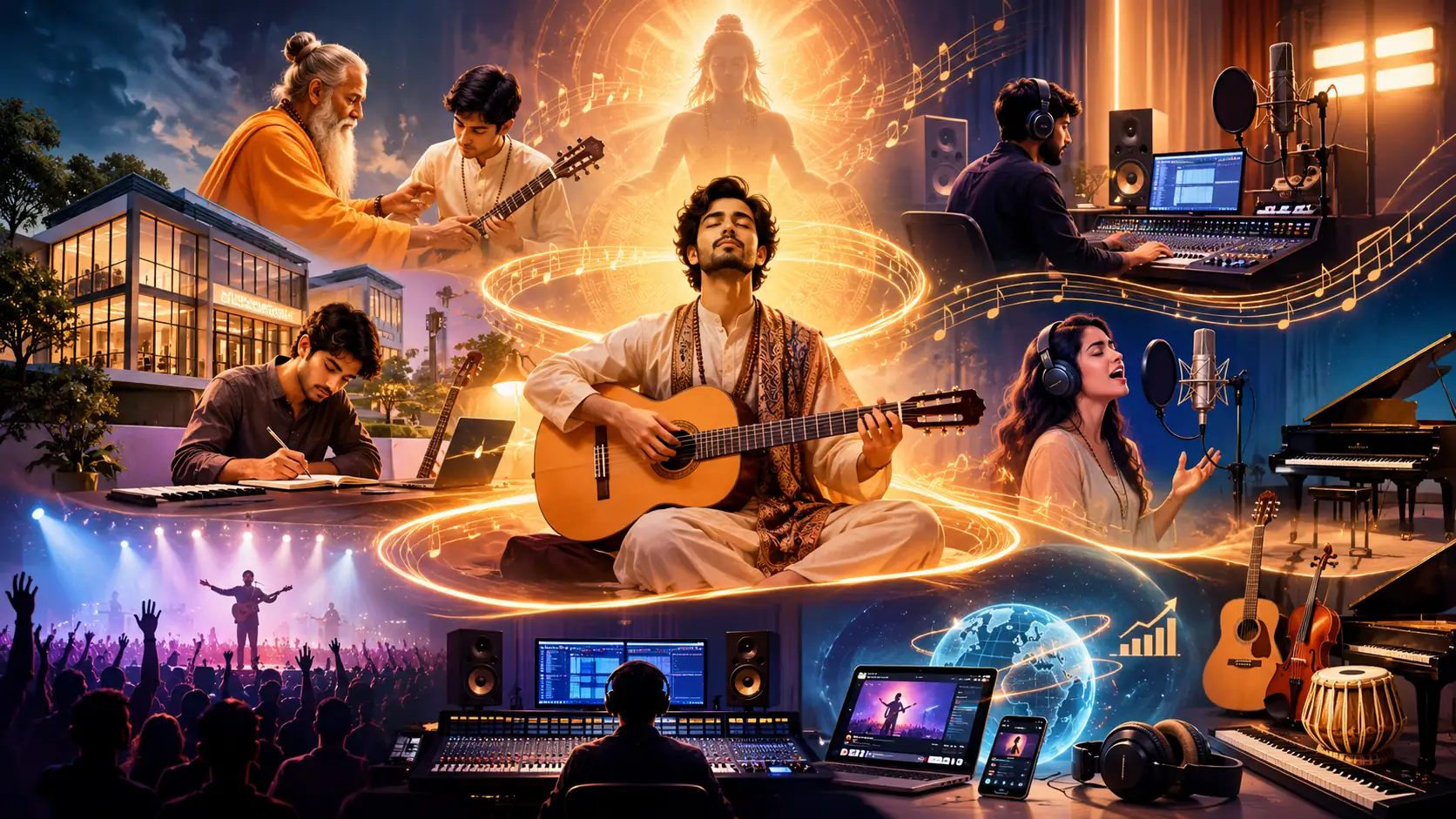
A lasting musical career is built through knowledge, discipline, creation, professional excellence and vision. Explore the connected path from learning music to developing an artistic identity and a sustainable place in the music industry.
A perspective for aspiring musicians, vocalists, instrumentalists, composers and independent artists.
 THE ARTIST JOURNEY · 01
Every year, aspiring musicians arrive in cultural capitals carrying something priceless: a dream. Some bring an instrument, others a voice, a notebook of lyrics or a collection of melodies. They may come from different backgrounds and levels of training, but they share one belief: one day, the world will hear their music.
Between dreaming of a musical career and building one lies an enormous journey. Talent alone does not guarantee longevity. A beautiful voice does not automatically become a professional recording voice; knowing an instrument does not necessarily make someone a complete musician; and a strong composition does not automatically become a commercially successful record.
Being discovered is not the same as being prepared. A sustainable musical career requires an architecture: knowledge, spiritual discipline, creative ability, professional excellence, intellectual-property awareness, relationships, infrastructure and a long-term vision.
The objective is not simply to become a singer, instrumentalist or composer. It is to become a complete artist who understands the art, commands the craft and builds lasting value.
THE ARTIST’S ARCHITECTURE
The Divine Trinity of Music
Learning. Creation. Promotion.
The philosophy of creation, preservation and transformation offers a useful way to understand a musical career. In this framework, three interconnected pillars must evolve together:
Learning
The creation of knowledge. Develop musical understanding, technical ability, listening, discipline and the foundations of craft.
GYANCreation
The expression of knowledge. Turn ideas, experiences and musical understanding into original compositions and meaningful work.
RACHNAPromotion
The expansion of that expression into the world. Connect music with audiences, collaborators, platforms and opportunities.
VISTARThese pillars must support one another. Learning develops the musician. Creation develops the music. Promotion develops its reach. Together, they develop the career.
Learning — The Foundation of Gyan
Before a musician can command an audience, they must learn to command their own instrument. For a vocalist, the first instrument is the human voice. For an instrumentalist, it is the instrument they have chosen to master. For every musician, the fundamental language remains music itself.
Can you identify a note simply by hearing it? Can you reproduce an unfamiliar melodic phrase? Can you understand the relationship between Sur, Swar, Laya and Taal? Can you recognise when pitch is unstable, rhythm is inaccurate or expression lacks emotional depth?
Sur and Pitch Discipline
Accuracy, pitch stability, intonation and tonal control.
Ear Training
Recognising, identifying, reproducing and understanding notes and intervals.
Sargam and Melodic Intelligence
Understanding the language, structure and movement of melodies.
Laya and Taal
Developing rhythmic precision, timing, groove and internal musical awareness.
Vocal Development
Projection, resonance, breath control, articulation, modulation and range.
Instrumental Understanding
Technique, expression, coordination and musical interpretation.
Musical Literacy
Reading, writing, interpreting and communicating musical ideas.
Performance Psychology
Confidence, concentration, consistency and emotional control.
The objective is not simply to perform a set of songs. It is to understand why those songs work, how they are constructed and how to create something original. A trained musician does not merely hear music. A trained musician understands music.
Creation — Transforming Knowledge into Art
Learning fills the mind. Creation gives that knowledge a voice. A melody may arrive in silence; a lyric may emerge from an experience; a composition may take shape during Riyaaz, reflection, travel or experimentation. Inspiration is only the beginning.
Transforming an idea into a professional musical production can involve original composition and songwriting, lyric development, arrangement, orchestration, vocal production, recording, live instrumental recording, digital audio programming, sound design, acoustic engineering, editing, mixing, mastering, music direction and artistic supervision.
Imagine
Collect a melody, lyric, rhythm, sound or creative idea.
Develop
Shape the idea through composition, arrangement and musical storytelling.
Produce
Record, edit and refine the performance with suitable creative and technical support.
Present
Prepare a finished work for release, performance, licensing or another intended use.
A beautiful composition deserves an equally considered presentation. Never allow a great musical idea to remain trapped inside an unfinished recording.
Promotion — Giving Your Music a Destination
Music must reach people. A composition that remains on a personal hard drive may be priceless to its creator, but its potential audience remains limited. The modern music industry asks artists to combine artistic excellence with intelligent positioning.
Identity
Artist branding, positioning and a recognisable creative direction.
Communication
Public relations, digital presence, content and visual storytelling.
Distribution
Release planning, distribution and streaming strategy.
Audience
Audience development, collaborations and strategic partnerships.
Opportunities
Live performances, corporate engagements and relevant professional networks.
Rights & Value
Intellectual-property awareness and commercial positioning.
Promotion is not about becoming famous overnight. It is about helping the right music reach the right audience through the right channels, consistently and intelligently.
Music: The Union of Spirituality and Professional Excellence
One dimension looks inward, towards the soul. The other looks outward, towards the world.
Sadhana
Discipline, listening, humility, refinement and the gradual transformation of the artist.
Vyapaar
Professional excellence, organisation, commercial understanding and the ability to build.
They need not contradict each other. When approached with the right understanding, they can strengthen one another.
Guru-Shishya Parampara: Knowledge Beyond Information
In Indian classical philosophy, the relationship between a Guru and a Shishya represents more than the transfer of information. It involves discipline, observation, humility, correction, dedication and the gradual refinement of an individual.
A digital tutorial can demonstrate a technique and a recorded lecture can explain a concept. Deeper musical development also requires attentive listening, personalised correction, sustained practice and meaningful guidance. A Guru may observe what a student does not yet recognise: an unstable note, uncontrolled breath, a lack of rhythmic awareness or expression that needs refinement.
Music as Meditation
What happens when a musician practises a single note with full attention? The mind settles, the body becomes attentive and the breath becomes conscious. Music can become a form of meditation: a carefully developed melody can become an expression of devotion, while a rhythmic cycle can become an exercise in discipline and inner balance.
The Sacred Seed — Beej, Parvarish and Creation
A composition can be understood as a seed. Inspiration may provide the idea, but the artist is responsible for nurturing it. Like a seed, a melody requires patience, nourishment, attention and time. Through Riyaaz, reflection and experimentation, a musical idea gradually develops into something that can touch other lives.
Let your music become an offering. Let your discipline become your devotion. Let your achievements become an expression of gratitude.
Vyapaar, Professional Excellence and the Realities of the Industry
Spirituality can teach a musician how to remain grounded. Professionalism helps the musician build. The global music industry includes education, technology, production, publishing, distribution, marketing, management, licensing, performances, intellectual property and investment.
Beyond Certificates: Education and Employability
Certificates can document participation, education and examination achievements. Professional opportunities, however, are generally built on demonstrated ability, relevant experience, artistic identity, reliability and the requirements of a specific opportunity.
The Singer
Professional vocal recording, diction, emotional interpretation, microphone technique and adapting to a music director’s requirements.
The Instrumentalist
Timing, notation, arrangements, recording protocols and clear musical communication.
The Composer
Composition, orchestration, production and intellectual-property understanding.
The Performer
Stagecraft, audience engagement, repertoire and professional conduct.
Survival Is Not the Same as Growth
Cafés, restaurants, private events and smaller venues can be valuable starting points. They can develop stage confidence, repertoire, audience awareness and performance discipline. A musician may also look beyond immediate payment for an individual performance and explore multiple sources of value.
Original music, recording opportunities, live performances, corporate engagements, teaching, licensing, collaborations, production work and brand partnerships may each form part of an individual career. The objective is to move from depending entirely on individual gigs towards an artistic identity supported by multiple professional opportunities.
Do not build a career that only pays you when you are physically performing. Build a musical identity that continues creating value beyond a single appearance.

The Science and Architecture of World-Class Music Production
From bedroom recordings to international production standards.
Technology has made music production more accessible. An aspiring composer can create an arrangement with a laptop, a digital audio workstation and a modest recording setup. Accessibility, however, should not be confused with excellence. Production environments differ in infrastructure, technical expertise and sonic expectations.
Personal and Independent Production
The starting point of creative exploration.
Typical infrastructure
- Home recording environments
- Entry-level audio interfaces
- Basic condenser microphones
- Digital audio workstations
- Software instruments and stock plugins
- Basic acoustic treatment
Typical applications
- Musical experimentation
- Composition demonstrations
- Songwriting references
- Practice recordings
- Early-stage independent projects
A bedroom studio can produce meaningful music. Limitations may relate to room acoustics, monitoring accuracy, recording conditions, experience and equipment.
Professional Independent Production
The transition from experimentation to professional delivery.
Typical infrastructure
- Professionally designed recording rooms
- High-quality microphones and preamps
- Professional monitoring systems
- Advanced digital audio workstations
- Professional recording and editing equipment
- Experienced recording and mixing engineers
Typical applications
- Independent commercial releases
- Professional vocal recordings
- Advertising and digital content
- Web-series and regional productions
- Professional artist development
The emphasis shifts towards consistency, clarity, controlled acoustics, reliable workflows and professional delivery standards.
Flagship and Elite Production
The pursuit of exceptional sonic and artistic excellence.
Typical infrastructure may include
- Purpose-built acoustic environments
- Flagship microphones such as the Neumann U 87
- Premium converters and recording chains
- Advanced monitoring environments
- High-end analogue and digital processing
- Live instrumental recording facilities
- Professional orchestral arrangements
- Experienced recording, mixing and mastering specialists
Typical applications
- Major film and OTT productions
- Large-scale musical arrangements
- Premium commercial releases
- International collaborations
- Complex orchestral and live recordings
At this level, production is not defined by equipment alone. It is shaped by the room, microphone, musician, engineer, arrangement and artistic vision.
A world-class microphone cannot manufacture musicality. An expensive studio cannot replace disciplined Riyaaz. A sophisticated mixing console cannot make an emotionally disconnected performance extraordinary. The artist brings the foundation; the infrastructure supports the vision; the professionals execute the production.

The 360-Degree Music Industry Ecosystem
Why an artist needs more than a music teacher or a recording studio.
Imagine an aspiring musician approaching a different organisation for every requirement: one for learning, another for recording, another for production, another for marketing, another for artist management, another for instruments, repairs, rentals and event bookings. Every new requirement introduces coordination, cost, uncertainty and the challenge of finding professionals who understand the artist’s larger vision.
This is where an integrated institutional model can become valuable. The music industry is not one isolated service; it is a network of capabilities that can support different stages of an artist’s journey.
Music Education and Academy
The foundation of the artist: structured education, Guru-Shishya Parampara, vocal and instrumental training, ear training, musical literacy, performance preparation, recording technique, music theory and long-term development.
Music Production and Record Label
The birthplace of original musical identity: compositions, songwriting, lyrics, music direction, live instrumentation, digital and analogue production, vocal recording, mixing, mastering, audio-visual releases and distribution.
Artist Management and Development
The professional architecture behind the artist: positioning, branding, career planning, representation, project development, collaboration management, commercial opportunities, partnerships and intellectual-property coordination.
Music Marketing and Digital Promotion
The connection between the artist and the world: digital marketing, social strategy, public relations, music-video promotion, streaming campaigns, audience development, websites, content and campaign management.
Studios and Production Infrastructure
The physical environment in which music comes alive: recording rooms, live recording spaces, rehearsal and jam spaces, voice-over and dubbing facilities, professional audio equipment, acoustic design and equipment rentals.
Instruments and Musical Commerce
The instrument and equipment pathway: choosing and purchasing instruments, exploring pre-owned options, accessing rentals, arranging eligible repairs and maintenance, and understanding the tools needed for practice, production and performance.
An integrated ecosystem does not mean every artist needs every service at once. It means the artist can identify the next requirement and connect with the appropriate specialist or venture when the time is right.
From Musical Learning to a Lasting Legacy
A musical career is not a single ladder with one destination. It is a connected process that may change as an artist’s ability, interests, resources and opportunities develop.
Build the foundation
Learn technique, listening, theory, rhythm, musical language and disciplined practice.
Develop an artistic voice
Explore repertoire, experiment, compose, write, arrange and understand creative identity.
Create finished work
Record, produce, refine and prepare music for its intended audience or application.
Build professional relationships
Collaborate with musicians, producers, engineers, managers, venues and creative teams.
Reach an audience
Develop an appropriate promotion, release, performance and audience strategy.
Protect and grow value
Understand rights, agreements, project costs, opportunities and the long-term value of original work.
The sequence is a practical framework, not a guarantee of outcomes. Each artist’s journey will be different, and the right combination of learning, production and professional support depends on their goals.
From Mumbai to a Global Musical Legacy
Musicians may begin in Mumbai, London, New York, Dubai, Los Angeles, Singapore or another cultural centre. Geography can shape the opportunities available, but a strong musical foundation travels with the artist.
A global outlook asks the musician to develop musical understanding, a clear identity, professional communication, collaborative ability and an awareness of how music is created, presented and experienced across different audiences and markets.
Rooted in practice.
Open to the world.
Preserve the depth of your musical foundation while remaining curious about new collaborators, audiences, technologies and creative possibilities.
Explore the SoulFul Music Ecosystem
Connected ventures for different stages of the musical journey.
The SoulFul ecosystem brings together ventures spanning education, production, instruments, studios, digital promotion, artist management, events and related business capabilities. Explore the relevant venture for your requirement and confirm its current services, scope and availability directly.
Learning & Artist Development
Creation, Production & Instruments
Promotion, Performance & Reach
Business & Global Ecosystem
The Architecture Is Built One Note at a Time
A musical legacy does not emerge from recognition alone. It grows from learning, practice, original creation, thoughtful production, professional relationships and the discipline to keep developing.
Music can be a spiritual practice, an intellectual discipline, an artistic expression, a profession and an enterprise. The architecture of a modern music career makes room for all of these dimensions without confusing one for another.
Let the practice deepen the artist. Let the artist give shape to the music. Let the music find its audience. And let each stage be supported by the knowledge, people and infrastructure it genuinely needs.
Learn with sincerity. Create with intention. Build with understanding. Share with purpose.
Frequently Asked Questions
How do you build a sustainable music career?
A sustainable music career can be developed by combining musical learning, disciplined practice, original creation, professional production, promotion, relationships and an understanding of the music business.
What are the three pillars of a musical career?
The framework in this article presents three connected pillars: Learning, Creation and Promotion. Learning develops knowledge, Creation expresses that knowledge through music, and Promotion helps the work reach an audience.
Why is Sadhana important for musicians?
Sadhana places attention on practice, listening, refinement and discipline. It encourages a musician to develop musical sensitivity and consistency alongside professional goals.
What is Guru-Shishya Parampara in music?
Guru-Shishya Parampara describes a teacher–student tradition built around guidance, observation, correction, humility, dedication and the gradual development of musical understanding.
What skills does a professional musician need?
A musician may need pitch and rhythm control, ear training, musical literacy, technique, performance confidence, collaboration, recording awareness and reliable professional conduct, depending on their chosen work.
What are the different levels of music production?
The article describes three broad tiers: personal and independent production, professional independent production, and flagship or elite production. The appropriate level depends on the project, room, equipment, expertise and artistic requirements.
Why do musicians need artist management and promotion?
Artist management and promotion can help organise positioning, career planning, partnerships, project development, audience growth and professional opportunities. The services required differ by artist and stage of development.
What is a 360-degree music industry ecosystem?
It is a connected set of capabilities across education, production, management, marketing, studios, instruments, rentals, events and related business services that can support different stages of an artist’s journey.
Can one musician build income from more than live performances?
Musicians may explore several forms of professional value, such as original music, recording, teaching, licensing, collaborations, production work, live performances and brand partnerships. Suitability and results vary by individual.
How can SoulFul support different stages of a musical journey?
The SoulFul ecosystem includes ventures across music education, production, instruments, studios, promotion, artist management, events and related services. Contact the relevant venture to confirm its current scope and availability.
Build Your Musical Journey with a Stronger Foundation
Whether you are beginning your musical education, developing original work, exploring production or looking for a relevant part of the wider music ecosystem, connect with the team that best matches your current requirement.
Confirm programme details, service scope and availability directly with the relevant venture.