

Drum: A Complete Guide to the Musical Instrument
Explore how drums are built, how they create sound, the different types of drums, major playing techniques, Indian percussion traditions and practical ways to learn and practise.
A drum is a percussion instrument that produces sound when its membrane or playing surface is struck.
Drums exist in many shapes, materials, sizes and playing traditions. Some are played with the hands, others with sticks or beaters, and many are built around a drumhead stretched over a resonating shell or frame.
The word “drum” therefore describes a broad family of instruments rather than one single design.
How Drums Work
Three fundamentals explain most drum designs: the vibrating surface, the resonating body and the way the player controls the strike.
Playing Surface
The drumhead or playing membrane vibrates after a stroke and creates the primary sound source.
Resonating Body
The shell, frame or body shapes projection, tone, sustain and the character of the instrument.
Technique
Hands, sticks, mallets, beaters, touch and dynamics influence attack, rhythm and expression.
Main Parts of a Drum
Construction varies across drum families, but most instruments can be understood through the relationship between the shell or frame, the drumhead, the tension system and the playing tools.
Drum Shell
The shell or body supports the drumhead and contributes to projection and tonal character.
Drumhead
The membrane is the surface that vibrates when the player strikes it.
Tension System
Ropes, lugs, rings or other hardware can control how tightly a drumhead is held.
Sticks & Beaters
Different sticks, beaters and mallets change attack, articulation and playing technique.
Types of Drums
There is no single universal drum design. Different cultures and musical settings developed drums for different voices, techniques and performance roles.
Hand Drums
Played mainly with the hands and fingers, often emphasizing detailed articulation and rhythmic patterns.
Explore learning →Frame Drums
A shallow frame supports the playing membrane and allows portable, expressive rhythmic playing.
See Indian examples →Barrel & Double-Headed Drums
Two playing surfaces can provide contrasting voices and a broader rhythmic palette.
Explore related drums →Tuned Drums
Drums can be tensioned to different pitches, enabling melodic or tonal rhythmic relationships.
Understand sound →Drum Set
A coordinated collection of drums and cymbals used in many modern performance styles.
Explore techniques →Folk & World Drums
Regional traditions developed distinctive drums around local music, ritual, dance and performance.
Explore Indian drums →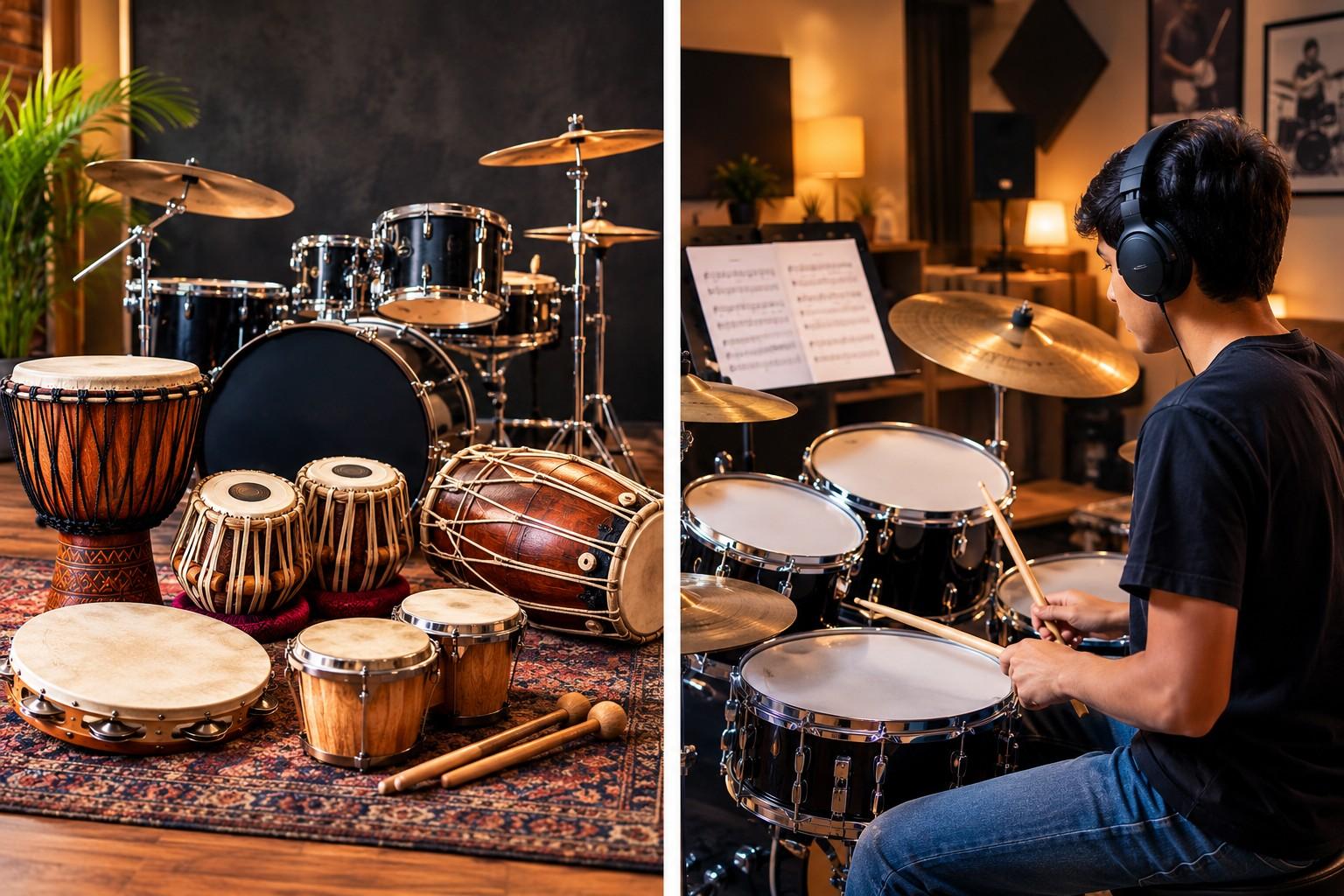
What Gives a Drum Its Sound?
Drum sound depends on the interaction of the head, body, tension, playing surface, stroke location and the player's dynamics.
How Drums Are Played
Technique connects the instrument to rhythm. The same drum can sound completely different when played with different touch, stroke placement, timing and dynamics.
Hand Technique
Finger, palm and hand positions can create contrasting tones, accents and muted sounds.
Stick Technique
Grip, rebound, placement and stroke height influence control and consistency.
Mallet Technique
Softer beaters can create different attacks and are used across several percussion traditions.
Dynamics
Controlling volume and accents turns repeated strokes into expressive rhythmic phrases.
Drum Practice for Beginners
Good practice is progressive: establish posture and timing first, then add coordination, speed, patterns and musical application.
Posture & Setup
Learn a stable position and make sure the instrument is comfortable to play.
Basic Strokes
Build consistent single strokes, alternating patterns and simple accents.
Timing
Practise with a steady pulse before increasing speed or complexity.
Musical Patterns
Move from isolated exercises into grooves, compositions and performance situations.
Drums in Indian Music
Indian music includes a wide range of drum and percussion traditions, each with its own construction, tuning, repertoire and technique.
| Instrument | Core identity | Common context |
|---|---|---|
| Dhol | Large, powerful double-sided drum | Celebrations, processions, weddings and live performance |
| Dholki | Compact double-headed drum | Folk, devotional, film and contemporary music |
| Sambhal / Sambal | Paired drums with contrasting registers | Maharashtrian Gondhal and related devotional folk performance |
| Tabla | Paired tuned hand drums | Indian classical, devotional, accompaniment and fusion |
| Djembe | Single goblet-shaped hand drum | Ensemble, world percussion, workshops and contemporary performance |
Dholki →
Explore Dholki learning, buying, rental, repair, performance and related support.
Dhol vs Dholki →
Compare the differences between Dhol and Dholki in size, sound, playing style and use.
Sambhal / Sambal →
Learn about the Maharashtrian paired drum and its Gondhal performance tradition.
How to Learn Drums
Choose a learning format based on the instrument, your goals, available practice time and the level of individual feedback you need.
Drum Classes
Structured classes provide progressive lessons, feedback and a regular learning routine.
Private Tuition
One-to-one lessons can focus closely on posture, coordination, sound and individual goals.
Online Learning
Online sessions can work well for rhythm, practice review, theory and selected technique work.
Drums in Live Shows & Events
Drummers work across concerts, cultural performances, studio sessions, weddings, festivals, educational workshops and event productions.
Live Music
Rhythmic accompaniment, grooves and dynamic performance in stage settings.
Cultural Events
Traditional and regional percussion can anchor ceremonies, festivals and cultural programmes.
Studio Work
Drums can be recorded acoustically or integrated into modern production workflows.
Workshops
Group percussion activities can build rhythm awareness and ensemble skills.
Choose the Right Drum for Your Goal
Before buying a drum, consider the musical tradition, playing method, portability, size, practice environment, budget and the teacher or repertoire you plan to follow.
For Beginners
Choose an instrument that is comfortable, practical and suitable for the technique you want to learn.
For Performance
Consider projection, durability, tuning, transport and the demands of the performance setting.
For Long-Term Learning
Choose an instrument that matches your tradition, teacher, repertoire and future practice goals.
Buy, Pre-Owned, Rent & Repair
A drum-learning journey may also include choosing equipment, maintaining it, renting for temporary use and preparing for recording or performance.
Buy →
Explore new instruments and related music equipment through the SoulFul ecosystem.
Pre-Owned →
Consider pre-owned instruments where budget, availability and condition make sense.
Rent →
Useful when you need an instrument for a temporary learning, recording or event requirement.
Repair →
Maintenance helps preserve playability, tuning stability and instrument condition.
Drum Learning & Music Ecosystem
The main Drum hub connects learning with instruments, practice, studio work, live performance and related music services.
SoulFul Musik Ventures
Explore the related businesses that support learning, instruments, practice, recording and performance.
Frequently Asked Questions About Drums
Simple answers to common beginner and instrument questions.
A drum is a percussion instrument that produces sound when a drumhead or playing surface is struck, creating rhythm, accents and tones.
Drums include hand drums, frame drums, barrel and double-headed drums, tuned drums, drum-set components and many regional folk instruments.
A strike makes the playing surface vibrate, and that vibration interacts with the drum body or resonator to produce sound.
Beginners can start with posture, grip, timing and simple strokes before progressing to more complex rhythmic patterns.
Indian and Western drum traditions use different designs, tuning systems, techniques and musical contexts, although the basic sound-production principle is related.
Some fundamentals can be taught online, especially rhythm, coordination and practice routines, while in-person lessons can make physical technique and instrument setup easier to observe.
Explore Drums, Learn the Technique & Build Your Rhythm
Use this Drum hub as the starting point for instrument research, learning, Indian percussion, practice and connected SoulFul music services.