
Police Band Bharti in India: A Complete Career Guide
Understand government recruitment pathways, Bandsman roles, eligibility, instruments, musical assessments and the professional training that helps an instrumentalist prepare with purpose.
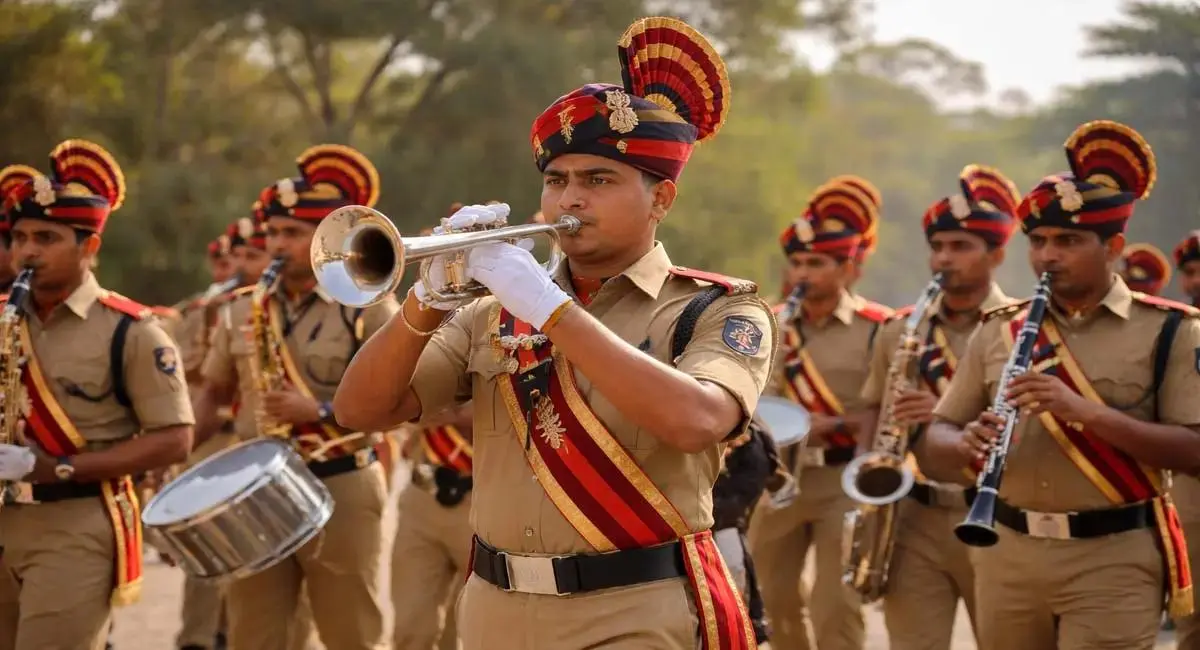
When Musical Talent Meets Government Service
For many young Indians, securing a position in a government department is an important career aspiration. Government service is associated with responsibility, institutional discipline, public service and long-term professional development.
While many candidates prepare for conventional government recruitment examinations, fewer understand the specialised employment opportunities available to trained musicians within police and uniformed-service organisations. One such pathway is Police Band Bharti.
Police bands are specialised musical units within certain police departments and uniformed organisations. Their responsibilities may include ceremonial performances, official parades, state functions, institutional events and commemorative occasions.
Institutional band musicians combine musical ability with professional discipline, teamwork and public-service responsibilities. They follow a conductor or bandmaster, maintain tempo, read arrangements and coordinate with other instrumentalists.
At SoulFul Musik Academy, the educational focus is to develop genuine musical competence and help learners understand the professional preparation involved in pursuing relevant opportunities.
Understanding the Government Recruitment System
01. How is police recruitment organised in India?
India has a constitutional federal structure in which responsibilities are distributed between the Union and State Governments. The Constitution places Police and Public Order in the State List of the Seventh Schedule. State police forces therefore operate under their respective state administrative and recruitment frameworks.
The Union Government also maintains central security organisations through the Ministry of Home Affairs (MHA). Recruitment authority, eligibility and selection procedures differ between state departments and central forces.
02. State police departments and central uniformed forces
State Police Departments
Examples include Maharashtra, Gujarat, Rajasthan, Uttar Pradesh, Madhya Pradesh, Karnataka, Kerala and Tamil Nadu Police. Recruitment follows the relevant state rules and notifications.
Central Uniformed Forces
Examples include BSF, CRPF, CISF, ITBP, SSB and Assam Rifles. Recruitment follows the applicable central scheme and force-specific rules.
03. What is the role of the Ministry of Home Affairs?
The MHA is a principal ministry responsible for internal security administration. Its Police-II Division deals with personnel, financial, administrative, parliamentary, audit and court matters relating to various Central Armed Police Forces. It also handles policy and schemes for recruitment of CAPF personnel.
The MHA does not conduct every police recruitment examination directly. Depending on the post and framework, recruitment may be administered by SSC, a designated force or a state recruitment authority.
04. What are the Central Armed Police Forces?
| Organisation | Broad functional area |
|---|---|
| Border Security Force (BSF) | Border security |
| Central Reserve Police Force (CRPF) | Internal security and public-order assistance |
| Central Industrial Security Force (CISF) | Security of designated industrial and critical infrastructure installations |
| Indo-Tibetan Border Police (ITBP) | Border guarding in the Himalayan region |
| Sashastra Seema Bal (SSB) | Border guarding along designated borders |
| Assam Rifles | Security and border-related responsibilities in the Northeast |
Some forces maintain institutional musical units, including brass bands and pipe bands. The existence of a band does not mean every force recruits musicians through the same notification or at the same time. Verify the exact recruitment category.

What Exactly Is Police Band Bharti?
05. Meaning and common post designations
Police Band Bharti refers to recruitment into designated musical positions or band-related cadres within a police organisation. Depending on the department and rules, notifications may use titles such as Police Bandsman, Police Band Constable, Constable (Band), Head Constable (Brass Band), Head Constable (Pipe Band) or another designated instrumental post.
These titles are not interchangeable. Use the exact designation in the applicable government notification.
Band duties may include ceremonial performances, official government functions, state ceremonies, police department celebrations, national and institutional commemorations, parade formations, marching music and coordinated ensemble performances. Duties depend on the department and posting.
06. Does Maharashtra Police have a separate Bandsman category?
Yes. Maharashtra Police's published Police Recruitment 2024–25 materials include Bandsman as a separate recruitment category alongside other police recruitment categories. The official portal also provides recruitment advertisements and vacancy information.
How to interpret this example
This demonstrates that musical recruitment can be advertised as a specific government employment category. It does not mean a new application window is currently open. The 2024–25 recruitment cycle has subsequent process updates; always check the current official portal for the latest notices.
Historical Maharashtra State Reserve Police Force rules refer to knowledge of brass-band instruments and musical experience, and indicate that band personnel may also be required to perform other police duties. Historical provisions must not be mistaken for complete current eligibility conditions.
07. Police Constable Bharti vs Police Bandsman Bharti
| Police Constable recruitment | Bandsman recruitment |
|---|---|
| General police constabulary role | Designated musical role within the organisation |
| General recruitment eligibility | Eligibility under the specific bandsman notification |
| Physical and written assessments as prescribed | Physical, written and potentially musical assessments as prescribed |
| No general assumption of instrumental proficiency requirement | Instrumental knowledge or experience may be required |
| Duties based on police posting | Musical and other departmental duties as assigned |
Not every Bandsman recruitment follows an identical assessment format. The notification establishes whether a practical examination, instrument test or proficiency assessment is required.
08. Instruments relevant to police bands
Police bands may include brass, woodwind, pipe-band and percussion sections. The instruments required depend on the ensemble and the recruiting authority's requirements.
Trumpet
Melody, fanfare and ceremonial passages.
Trombone
Harmonic support, melodic lines and slide technique.
French Horn
Harmonic support and orchestral colour.
Euphonium
Rich middle register and supporting voices.
Tuba
Bass foundation and harmonic stability.
Snare Drum
Marching rhythm, rudiments and rhythmic precision.
Bass Drum
Pulse, accents and ensemble foundation.
Flute / Clarinet / Saxophone
Melodic and upper-register passages where included.

How Government Police Recruitment Actually Works
09. How are government vacancies created?
A department assesses staffing requirements, sanctioned posts, existing vacancies, retirements and organisational needs. Vacancies are filled under applicable recruitment rules and administrative approvals. For a specialist band post, the department may also identify requirements within its musical unit and sanctioned cadre.
- Departmental requirement
Identification of staffing needs and sanctioned vacancies. - Administrative approval
Approval under applicable government rules and procedures. - Official recruitment notification
Publication of vacancies, eligibility and selection stages. - Applications and screening
Online application, document checks and eligibility verification. - Selection assessments
Written, physical, musical or other tests as prescribed. - Medical and document verification
Checks under the relevant recruitment rules. - Merit list and appointment
Final selection, allocation and appointment under applicable rules.
This is an illustrative administrative sequence. Actual stages and their order vary by recruitment authority.
10. Which authorities may conduct recruitment?
| Authority | General responsibility |
|---|---|
| State Home Department | State-level police administration and policy |
| State Police Department | Departmental requirements and recruitment |
| State recruitment authority | Recruitment administration where assigned |
| Ministry of Home Affairs | Central police and CAPF administration |
| Staff Selection Commission | Examinations assigned to SSC |
| Individual CAPF | Force-specific administration and selection as prescribed |
11. What is the role of SSC in central police recruitment?
The Staff Selection Commission conducts examinations for posts assigned to it. Its Constable (General Duty) examination covers designated Central Armed Police Forces and other organisations specified by the relevant notification.
The SSC GD framework generally contains stages such as a computer-based examination, Physical Standard Test, Physical Efficiency Test, medical examination and document verification. However, SSC GD must not be assumed to be the correct examination for a specialist musical position. Check the specific notification for a dedicated band post.
12. Understanding eligibility requirements
There is no single universal eligibility standard for all Police Band Bharti opportunities. A notification may prescribe:
- Age limit: Minimum and maximum age, including applicable category relaxations.
- Educational qualification: Minimum school or other prescribed academic qualification.
- Physical standards: Height, chest measurements where applicable, weight and other criteria.
- Medical fitness: Vision and other health-related standards specified for the post.
- Musical qualification or experience: Instrumental proficiency, recognised qualifications or experience where required.
- Nationality, domicile and documents: Conditions and records prescribed by the recruiting authority.
Do not copy eligibility requirements from a general constable notification and apply them automatically to a specialist bandsman post.
13. What happens during selection?
| Possible assessment | What it may evaluate |
|---|---|
| Application screening | Basic eligibility |
| Document verification | Educational and personal records |
| Physical Standard Test | Prescribed physical measurements |
| Physical Efficiency Test | Physical performance |
| Written examination | General knowledge and notified subjects |
| Instrumental proficiency test | Practical musical ability, if prescribed |
| Medical examination | Medical fitness |
| Final merit process | Selection under notified criteria |
Some assessments may be qualifying while others may contribute to final merit. The official notification determines the distinction.
14. What is a musical proficiency test?
Where prescribed for a specialist musical post, a practical assessment may examine instrument handling, tone production, pitch accuracy, rhythm and tempo, note recognition, notation reading, prescribed compositions, technical exercises, musical memory and performance consistency.
For marching-band or ensemble positions, coordination and the ability to maintain a steady pulse may also be relevant. There is no universal practical examination syllabus applicable to every state and force. Prepare for the exact instrument and format stated in the notification.
What Should a Police Band Aspirant Learn?
15. Musical foundations: Sur, Laya, Taal, ear training and notation
Instrumental proficiency should be built upon strong musical foundations. Copying finger movements and memorising passages can be useful introductory exercises, but they cannot replace systematic musical understanding.
Pitch
Understand pitch, tonal relationships, note accuracy and musical intervals.
Tempo
Develop pulse, speed control, rhythmic consistency and tempo awareness.
Metric structure
Understand rhythmic organisation, subdivisions, beats and musical cycles.
Listening
Recognise, reproduce and distinguish pitches, intervals and patterns.
Notation
Interpret musical symbols, note values, rhythms and written arrangements.
16. Instrument-specific technical training
| Instrument | Important technical areas |
|---|---|
| Trumpet | Embouchure, breath support, tonguing, articulation and register |
| Trombone | Slide positions, embouchure, breath control and intonation |
| Tuba | Breath management, tone production and low-register accuracy |
| Euphonium | Embouchure, fingering, articulation and tonal control |
| French Horn | Embouchure, pitch accuracy and hand technique |
| Clarinet | Reed control, fingering, articulation and breath support |
| Flute | Embouchure, breath control, fingering and tone production |
| Snare Drum | Stick control, rudiments, subdivisions and rhythmic precision |
| Bass Drum | Pulse, stroke control and ensemble coordination |
Every instrument has distinct technical requirements. Proficiency requires repetition, observation, correction, practice and progressive assessment.
17. Understanding marching-band music
Marching-band musicianship combines musical and physical coordination. Musicians perform in synchronisation while following an organised formation and maintaining a consistent tempo.
- Marching pulse and tempo consistency
- Rhythmic precision and ensemble balance
- Dynamic control and uniform articulation
- Musical cues and visual coordination
- Following a conductor or drum major
- Performance discipline and collective timing

18. Reading Western musical notation
Many brass-band and marching-band arrangements use Western staff notation. Candidates preparing for such instruments should become familiar with treble clef, bass clef, note names, key signatures, time signatures, note durations, rests, dotted notes, articulation, dynamics, tempo markings, bar lines and measures.
Transposing instruments are another consideration. A B-flat trumpet and a concert-pitch instrument may read different written notes to produce the same sounding pitch. Understanding transposition helps musicians work with written arrangements and ensembles.
The SoulFul Musik Academy Training Methodology
19. From absolute beginner to instrumental performer
A candidate with no previous musical background may need a structured learning journey. The programme should reflect the learner's starting point, selected instrument, practice consistency and professional objectives.
- Musical foundation
Sur, Laya, Taal, pitch recognition, ear training and rhythmic understanding. - Instrument familiarisation
Instrument anatomy, maintenance, posture, handling and basic technique. - Technical development
Fingering, articulation, tone production, breath control or percussion technique. - Music reading
Staff notation, rhythmic interpretation, sight-reading and terminology. - Repertoire development
Progressive exercises, melodies, marches and instrument-specific material. - Ensemble development
Listening, coordination, timing, dynamics and collective performance. - Professional preparation
Practical evaluation, mock auditions and preparation aligned with applicable requirements.
20. The 100-hour structured learning framework
SoulFul Musik Academy follows a structured 100-hour programme model. Rather than treating education as disconnected hourly lessons, this framework is designed around continuous learning, guided practice and progressive skill development.
A 100-hour programme can provide a foundation for understanding an instrument and developing initial practical competence. It is not a guarantee of professional mastery or recruitment success. Outcomes depend on the instrument, starting ability, attendance, practice and individual progress.
| Learning area | Development objective |
|---|---|
| Musical foundation | Pitch, rhythm and listening |
| Instrument technique | Correct execution and control |
| Music theory | Musical understanding |
| Notation | Reading and interpreting scores |
| Practical repertoire | Performance development |
| Assessment | Identifying strengths and weaknesses |
Advanced professional development may require training beyond the initial programme.
21. The importance of Riyaz and daily practice
Instrumental development does not happen through classroom instruction alone. Consistent, deliberate practice is essential. A useful practice routine can include:
- Technical warm-up exercises
- Pitch and tone development
- Scales and technical patterns
- Rhythm and timing exercises
- Notation-reading practice
- Repertoire revision
- Listening and self-evaluation
- Recording and reviewing performances
Duration and intensity should suit the student's experience and instrument. Consistency is more useful than irregular periods of excessive practice.
22. Preparing for a Police Band audition
Preparation should be guided by the actual recruitment notification. General performance objectives may include correct instrument handling, consistent tone, accurate notes and rhythm, controlled articulation, notation familiarity, selected repertoire, tempo maintenance, understanding musical instructions and performing consistently under observation.
Career Opportunities Beyond Police Band Bharti
23. Is Police Band recruitment the only option for an instrumentalist?
No. A student who develops genuine instrumental competence can explore multiple pathways. Each opportunity has its own professional standards, auditions, vacancies and eligibility requirements.
Government and institutional bands
Police bands and other eligible institutional musical units, subject to their recruitment rules.
Military and uniformed-service music
Eligible military or uniformed-service musical organisations through their specific selection systems.
Orchestral performance
Participation in orchestras, ensembles and live musical productions.
Studio recording
Instrumental recording, session work and music-production collaborations.
Music education
Instrumental instruction, private teaching and structured educational programmes.
Live entertainment and events
Event bands, ceremonial productions and independent performance assignments.
The objective is to build skills that remain useful even if a candidate chooses a different professional direction.
Parents, Students and Career Planning
24. What should parents understand before enrolment?
Police Band Bharti is a government recruitment opportunity, not an admission-based career programme. Enrolling in a music academy does not guarantee a government job. The academy's responsibility is musical education and instrumental development; the government department defines eligibility, announces vacancies, conducts selection and issues appointments.
Before enrolment, families should consider the student's interest in the instrument, time needed for musical development, relevant recruitment eligibility, academic commitments, physical fitness where required, irregular vacancy schedules and alternative professional music pathways.
25. Can a complete beginner prepare?
A beginner can start learning an instrument without previous musical experience. However, the time required to reach the level demanded by a recruitment process varies. The learner must develop musical understanding, instrument-specific technique and consistent performance, while separately satisfying the recruiting authority's eligibility rules.
26. Can music be pursued alongside academic education?
Yes. A structured practice schedule can help students develop musical skills alongside school, college or other commitments. Academic qualifications remain important wherever government recruitment rules prescribe them. Music and formal education need not be treated as mutually exclusive.
Why SoulFul Musik Academy?
27. Structured education over shortcut-based preparation
SoulFul Musik Academy's teaching philosophy is rooted in the Guru-Shishya Parampara, structured educational commitments and progressive musical development. The focus is on building musicians who understand their craft.
Foundation before performance
Build musical fundamentals rather than relying entirely on imitation.
Understanding before memorisation
Develop notation, pitch, rhythm and instrumental understanding.
Accuracy before complexity
Make advanced repertoire meaningful by strengthening underlying technique.
Practical application
Translate musical understanding into actual instrumental performance.
Long-term development
Explore institutional bands, professional ensembles, recording, performance and music education.
Individual progress
Shape training around actual ability and learning requirements, not artificial timelines.
28. Learning formats at SoulFul Musik Academy
In-studio offline training
Instructor guidance, practical instrumental instruction and structured learning in the academy environment.
Private home tuition
Individualised instruction at the student's residence, subject to availability and applicable programme terms.
Online one-on-one training
Guided remote learning for students who require instruction from different locations.
Choose a learning format according to location, instrument, instructor availability and educational requirements.
Official Recruitment Information and Important Resources
29. Where should candidates check genuine government notifications?
Use official government websites and published recruitment notifications rather than social-media forwards, unverified advertisements or third-party recruitment claims.
CRPF Group C Band Posts document: verify its legal status
The CRPF-hosted 2024 document concerning Group C Brass Band and Pipe Band posts is useful as a reference to the specialised cadre. The linked copy is headed “For Comments of Stakeholders”; do not cite that copy as a final operative Gazette rule without locating and verifying the final Gazette notification.
Open the CRPF-hosted 2024 stakeholder document ↗
30. What candidates must verify before applying
- Whether the vacancy is specifically for Bandsman or another designated musical post.
- Whether the post is permanent, temporary or contractual, as stated in the advertisement.
- The exact educational qualification, age limit and applicable relaxations.
- Prescribed physical standards and medical requirements.
- Whether instrumental experience or recognised qualifications are required.
- Which instruments are accepted for the specific post.
- Whether a practical musical test or written examination is conducted.
- How the final merit list is prepared.
- The official application fee, application dates and deadlines.
- Service conditions, pay level and appointment terms.
Developing the Next Generation of Musicians
At SoulFul Musik Academy, musical education is a serious discipline with the potential to create meaningful professional opportunities. A student who begins without a musical background can gradually develop pitch, rhythm, notation, instrumental technique and performance ability through consistent training.
For candidates interested in Police Band Bharti, this development can provide a musical foundation relevant to the chosen pathway, subject to the requirements of the recruiting authority.
For students who eventually choose another direction, the same foundation can support professional performance, studio work, music education and independent artistic development.
Our commitment is to provide a structured educational environment where musical ability develops through understanding, discipline and practical application.
A government career may begin with your musical journey. Learn the instrument. Understand the music. Develop professional competence.
Police Band Bharti FAQs
1. Is Police Band Bharti a government job?
2. Is Police Band Bharti conducted every year?
3. Can a beginner apply for Police Band Bharti?
4. Is a music degree compulsory?
5. Is there a separate musical examination?
6. Can candidates from other states apply for Maharashtra Police Bandsman recruitment?
7. Does SSC conduct every Police Band recruitment?
8. Can students learn an instrument without previous experience?
9. Does SoulFul Musik Academy guarantee Police Band selection?
10. Can instrumental training lead to careers beyond government service?
Explore the SoulFul Musik World Ventures
Music education connects with instruments, practice, recording, events and artist development. Explore the wider SoulFul Musik World ecosystem.
Learning and artist development
Instruments and production infrastructure
Promotion and performance
Business and global network
If You Have a Musical Dream, We Have a Musical Way.
Learn the instrument. Understand the music. Develop professional competence through structured music education, instrumental training and practical application.
Begin Your Musical Journey ↗Music education and training only. No government appointment, vacancy or recruitment outcome is guaranteed.